Cubic Yards
Cubic Yards
A Flowable Fill Calculator is a specialized construction estimation tool used to determine the required volume of flowable fill material in cubic yards or cubic meters. It calculates material needs based on excavation dimensions such as length, width, and depth. Additionally, it may include a safety factor to account for irregular surfaces, over-excavation, and material loss. This tool is widely used in civil engineering, road construction, and utility installation projects. By converting field measurements into precise material quantities, it ensures cost-effective procurement, reduces waste, and improves overall project planning accuracy for contractors and site engineers.
Detailed explanations of the calculator's working
The Flowable Fill Calculator works by converting physical trench or excavation measurements into volumetric requirements. First, the user inputs the length, width, and depth of the area in feet. The calculator multiplies these values to determine the total cubic feet of space. Then, it converts this volume into cubic yards by dividing the result by 27, since one cubic yard equals 27 cubic feet. To enhance accuracy, a safety factor is often applied to compensate for uneven surfaces, soil variations, and minor wastage during placement. The calculator automates these steps instantly, eliminating manual errors and ensuring precise material estimation for construction professionals.
Formula with Variables Description
Formula

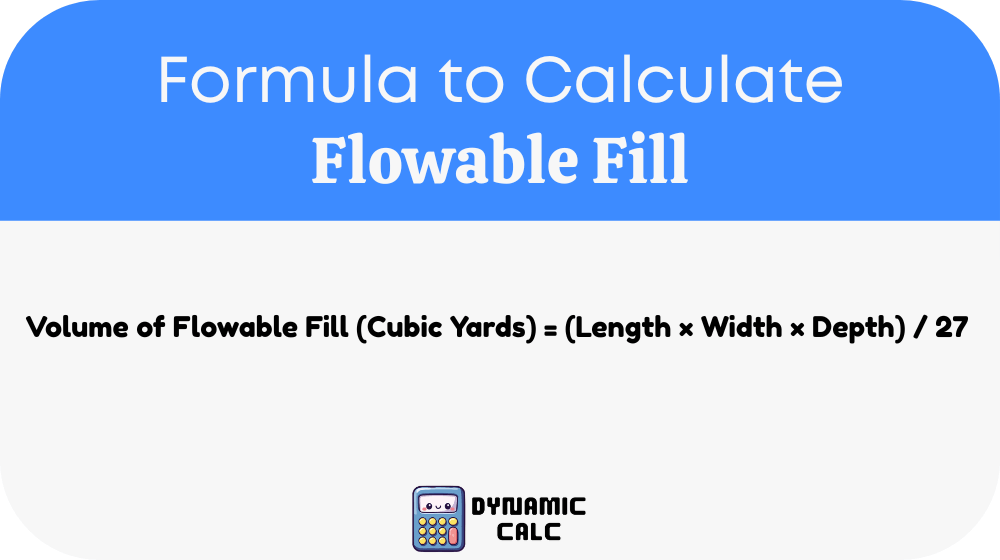
Detailed Formula with Safety Factor
Total Volume of Flowable Fill (Cubic Yards) = [(Length × Average Width × Average Depth) / 27] × (1 + Safety Factor)
Where:
- Length = length of trench or area in feet
- Average Width = average width of trench or area in feet
- Average Depth = average depth of trench or area in feet
- Safety Factor = 0.05 to 0.10 (for over-excavation, waste and irregularities)
General Reference Table
| Length (ft) | Width (ft) | Depth (ft) | Volume (Cubic Yards) |
|---|---|---|---|
| 10 | 2 | 2 | 1.48 |
| 20 | 3 | 2 | 4.44 |
| 30 | 4 | 3 | 13.33 |
| 50 | 5 | 3 | 27.78 |
| 100 | 6 | 4 | 88.89 |
This table provides quick reference values for common construction scenarios, helping users estimate material requirements without repeated manual calculations.
Example
Consider a trench with the following dimensions:
Length = 40 feet
Width = 3 feet
Depth = 2.5 feet
Safety Factor = 0.10
Step 1: Calculate volume in cubic feet
Volume = 40 × 3 × 2.5 = 300 cubic feet
Step 2: Convert to cubic yards
300 / 27 = 11.11 cubic yards
Step 3: Apply safety factor
Total Volume = 11.11 × (1 + 0.10) = 12.22 cubic yards
Final required flowable fill = 12.22 cubic yards
Applications with subheadings
Construction Backfilling
Flowable fill is widely used for backfilling foundations, trenches, and structural voids. The calculator ensures precise material estimation, preventing overuse or shortage during construction projects.
Utility Trench Filling
It is commonly applied in electrical, plumbing, and telecom trench backfilling. Accurate calculation helps protect underground utilities and ensures stable ground support after installation.
Roadway Subbase Applications
In road construction, flowable fill is used as a subbase material. The calculator helps engineers determine exact material requirements for stable road foundations and long-lasting infrastructure performance.
Most Common FAQs
1. What is a Flowable Fill Calculator used for?
A Flowable Fill Calculator is used to estimate the amount of flowable fill material required for construction projects. It helps engineers and contractors calculate volume based on trench or excavation dimensions. This ensures accurate planning, reduces material waste, and improves cost efficiency. It is especially useful in civil engineering projects where precision in material estimation is critical for structural stability and project success.
2. Why is a safety factor included in the calculation?
A safety factor is included to account for real-world uncertainties such as uneven surfaces, over-excavation, and material settlement. Construction sites rarely have perfectly uniform dimensions, so the safety factor ensures that enough material is available. Typically ranging from 0.05 to 0.10, it helps avoid shortages during execution and ensures smooth project completion without delays or additional procurement costs.
3. How accurate is a Flowable Fill Calculator?
A Flowable Fill Calculator is highly accurate when correct measurements are provided. However, its accuracy depends on the precision of input data such as length, width, and depth. While it eliminates manual calculation errors, field variations can still affect final results. That is why engineers often apply a safety factor to improve reliability and ensure practical on-site accuracy.