A Unistrut Load Capacity Calculator is an engineering calculation tool that determines the maximum allowable load a Unistrut channel can carry without exceeding its structural limits. It considers factors such as span length, material strength, support type, and applied force distribution. Unistrut systems consist of steel channels and fittings used to support piping, wiring, and mechanical equipment. The calculator ensures that these components remain within safe stress and deflection limits. Additionally, it helps prevent overloading and structural deformation. In practical use, it provides engineers with quick, reliable values for planning safe installations in construction and industrial projects.
Detailed Explanation of How the Calculator Works
The Unistrut Load Capacity Calculator works by analyzing structural load distribution across a supported beam system. First, it requires input values such as span length, allowable stress of material, and moment of inertia. Then, it applies engineering equations based on beam theory to estimate maximum load before deformation occurs. The calculator evaluates bending stress and deflection limits to ensure structural safety. Furthermore, it compares calculated values with permissible load standards for steel Unistrut channels. The output provides safe working load capacity, helping engineers avoid overloading risks. Ultimately, it simplifies complex structural analysis into quick, usable engineering results for field and design applications.
Formula with Variables Description

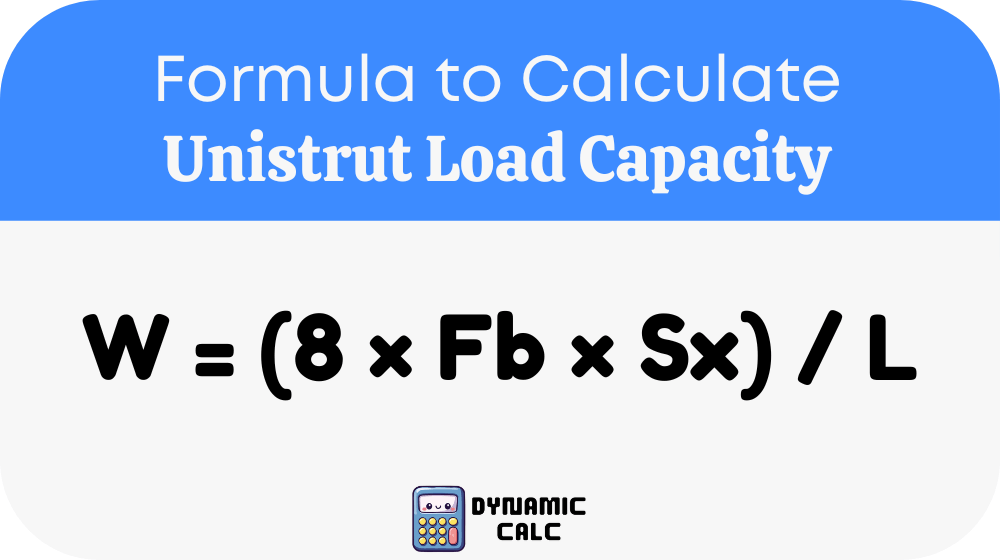
Where:
W = Maximum allowable load (N or kg depending on system)
Fb = Allowable bending stress of material (N/mm²)
Sx = Section modulus of Unistrut channel (mm³)
L = Span length between supports (mm)
This formula is widely used in structural engineering to determine safe load capacity under uniform loading conditions. It ensures that the applied load does not exceed the bending strength of the Unistrut profile. Additionally, it helps maintain structural stability and reduces the risk of failure due to excessive stress concentration.
Reference Table: Common Values & Engineering Conversions
| Parameter | Description | Common Range / Value |
|---|---|---|
| Steel Yield Strength | Material strength limit | 250 – 350 MPa |
| Unistrut Span Length | Distance between supports | 500 mm – 6000 mm |
| Safety Factor | Engineering safety margin | 1.5 – 3.0 |
| Load Type | Distribution type | Uniform / Point Load |
| Section Modulus (Sx) | Beam resistance factor | Varies by profile size |
| Unit Conversion | 1 kN | 1000 N |
| Unit Conversion | 1 kg load | 9.81 N |
This table helps users quickly estimate design parameters without performing repeated manual calculations, improving efficiency in engineering workflows.
Example
Consider a Unistrut channel with the following parameters: Fb = 250 N/mm², Sx = 5000 mm³, L = 2000 mm
Using the formula: W = (8 × 250 × 5000) / 2000
Step-by-step calculation: W = (10000 × 5000) / 2000
W = 50,000,000 / 2000
W = 25,000 N
Final result: The maximum allowable load is 25,000 N, which is approximately 2,549 kg under ideal conditions. However, safety factors must always be applied in real-world applications.
Applications
Construction and Structural Engineering
Unistrut Load Capacity Calculator plays a vital role in building frameworks, support systems, and infrastructure development. Engineers use it to ensure beams and channels can safely carry expected loads without deformation or failure.
Electrical and Mechanical Installations
It is widely used for supporting cable trays, piping systems, and HVAC ducts. Accurate load calculation ensures stability in suspended systems and prevents installation hazards.
Industrial Equipment Support Systems
Factories and industrial plants rely on Unistrut structures for machinery support and racking systems. The calculator ensures safe load distribution and prevents structural overload during continuous operation.
Most Common FAQs
1. What is the purpose of a Unistrut Load Capacity Calculator?
A Unistrut Load Capacity Calculator is designed to estimate the maximum safe load a Unistrut channel system can carry. It helps engineers and installers prevent structural failure by ensuring that applied loads remain within safe limits. Moreover, it improves safety compliance and design accuracy in construction and industrial applications. This tool simplifies complex structural engineering calculations into practical outputs that can be used in real-world projects without requiring advanced manual computations.
2. Why is load capacity important in Unistrut systems?
Load capacity is crucial because Unistrut systems are often used to support heavy mechanical and electrical installations. If the load exceeds safe limits, it may lead to bending, deformation, or complete structural failure. Therefore, calculating load capacity ensures long-term durability and safety. Additionally, it helps engineers maintain compliance with building standards and reduces maintenance costs caused by structural damage or miscalculations.
3. Can the calculator be used for all Unistrut sizes?
Yes, the calculator can be applied to different Unistrut channel sizes as long as correct input values are used. Each profile has a different section modulus and strength rating, which must be considered during calculations. By adjusting these parameters, users can accurately determine load capacity for various channel types used in construction, electrical systems, and industrial frameworks.