The Step Dance People Requirement Calculator is a structured estimation tool used to determine the optimal number of participants needed for a step dance performance. It evaluates key performance variables such as stage area, dance density, formation complexity, timing duration, spacing requirements, coordination factor, and movement intensity. By analyzing these inputs, it produces a practical estimate of how many dancers are required to execute a synchronized routine without overcrowding or spacing issues. This calculator is widely used in event planning, educational performances, and cultural festivals where precision in group coordination directly impacts visual appeal and safety during live performances.
Detailed Explanation of the Calculator's Working
The Step Dance People Requirement Calculator works by analyzing spatial and performance-related variables to generate a reliable group size estimate. First, it considers the available performance area and divides it by the average space required per dancer. Then, it adjusts the result based on choreography density, formation complexity, and synchronization timing. Additionally, it factors in movement intensity and coordination efficiency, which can increase or decrease the number of required performers. Transitioning from raw space calculations to performance realism, the calculator ensures that both artistic and safety requirements are balanced. As a result, users can avoid overcrowded stages or underfilled performances, achieving a visually balanced and well-coordinated step dance arrangement.
Formula with Variables Description

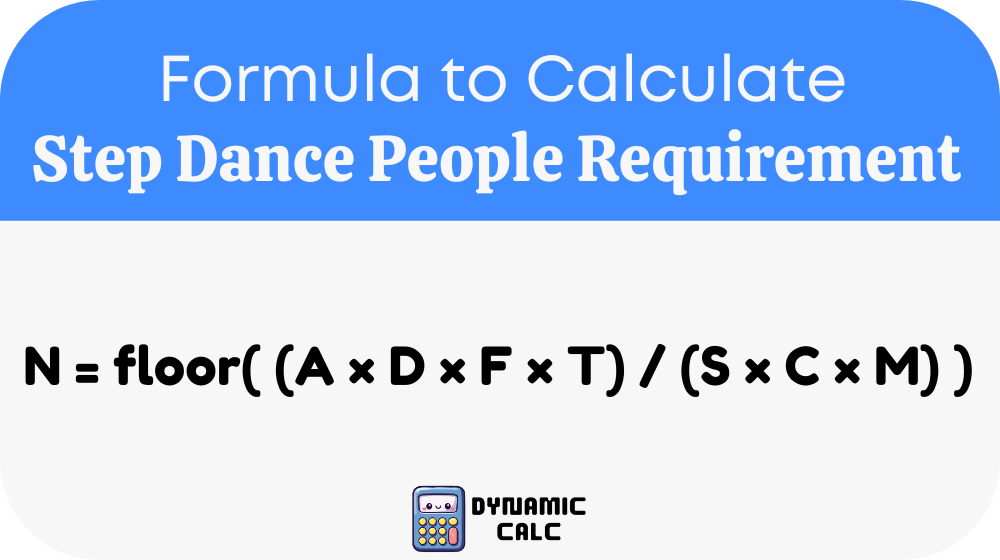
Where:
N = Number of dancers required
A = Available stage area (square meters)
D = Dance density factor (spacing requirement per dancer)
F = Formation complexity factor
T = Total performance duration factor
S = Space per dancer requirement
C = Coordination efficiency factor
M = Movement intensity multiplier
Quick Reference Table for Step Dance Planning
| Stage Area (m²) | Dance Style Complexity | Avg Space per Dancer | Estimated Dancers |
|---|---|---|---|
| 50 | Low | 2 m² | 10–12 |
| 100 | Medium | 2.5 m² | 18–22 |
| 150 | High | 3 m² | 25–30 |
| 200 | Very High | 3.5 m² | 30–40 |
This table helps organizers quickly estimate group size without performing manual calculations, improving planning speed and accuracy for events and rehearsals.
Example
For a stage area of 120 m², medium complexity choreography, and moderate spacing requirements, assume:
A = 120, D = 1.2, F = 1.1, T = 1.0, S = 2.5, C = 1.0, M = 1.1
N = floor( (120 × 1.2 × 1.1 × 1.0) / (2.5 × 1.0 × 1.1) )
N = floor(158.4 / 2.75)
N = floor(57.6)
N = 57 dancers
This result shows how stage conditions and performance intensity directly influence group size requirements.
Applications with Subheadings
School Performances
In school-level performances, this calculator helps teachers determine appropriate group sizes for assemblies, annual functions, and cultural days. It ensures that students are neither overcrowded nor spaced too far apart, which improves synchronization and safety during practice and live shows.
Cultural Stage Shows
For cultural events and festivals, organizers use the calculator to design visually balanced group performances. It helps maintain traditional step dance patterns while optimizing stage usage. This ensures audience engagement and professional presentation quality.
Competitive Step Dance Teams
In competitive environments, precision is critical. The calculator assists choreographers in selecting the ideal number of dancers to maximize scoring potential based on formation complexity, timing accuracy, and visual impact on judges.
Most Common FAQs
1. What is a Step Dance People Requirement Calculator?
The Step Dance People Requirement Calculator is a planning tool used to estimate how many dancers are needed for a synchronized step dance performance. It considers stage size, choreography complexity, spacing, and movement intensity to provide an accurate group size recommendation. This helps organizers avoid overcrowding and ensures smooth performance execution. It is widely used in schools, cultural events, and professional stage shows for better planning and coordination.
2. Why is calculating the number of dancers important?
Calculating the number of dancers is important because step dance relies heavily on timing and spatial coordination. If too many dancers are used, the stage becomes crowded, increasing the risk of collisions and reducing visual clarity. If too few dancers are used, the performance may look incomplete or unbalanced. Therefore, accurate calculation ensures safety, improves artistic presentation, and maintains synchronization throughout the performance.
3. Can stage size affect step dance group planning?
Yes, stage size plays a major role in determining how many dancers can perform effectively. A larger stage allows more dancers with greater spacing, which supports complex formations. On smaller stages, fewer dancers are required to maintain safety and visual clarity. The calculator adjusts group size based on available space to ensure optimal performance quality and avoid overcrowding during movement transitions.