A percentage calculator is a digital or manual calculation tool designed to determine percentage values, increases, decreases, ratios, and comparisons between numbers. It converts numerical relationships into percentages using standardized mathematical formulas. Since percentages represent proportions out of 100, they provide a universal way to compare quantities across different contexts. For example, businesses use percentages to measure profits and losses, while students use them to calculate grades and averages. In addition, healthcare professionals rely on percentage-based measurements for statistical reporting and nutritional analysis. A percentage calculator helps users perform these calculations efficiently while maintaining mathematical accuracy, consistency, and clarity for educational, financial, commercial, and scientific purposes.
Detailed Explanations of the Calculator’s Working
A percentage calculator works by applying mathematical formulas that convert ratios or portions into percentage values. The calculator accepts numerical inputs and processes them according to the selected calculation type. Users can determine what percentage one number represents of another, calculate percentage increases or decreases, or find a percentage of a total value.
For example, when calculating a percentage of a number, the calculator multiplies the percentage value by the total number and then divides the result by 100. Similarly, when determining percentage growth, the calculator compares the difference between old and new values before converting the result into percentage form. Because the process follows standard mathematical principles, the results remain reliable for educational, financial, commercial, and statistical applications.
Formula with Variables Description
The standard percentage formula is:

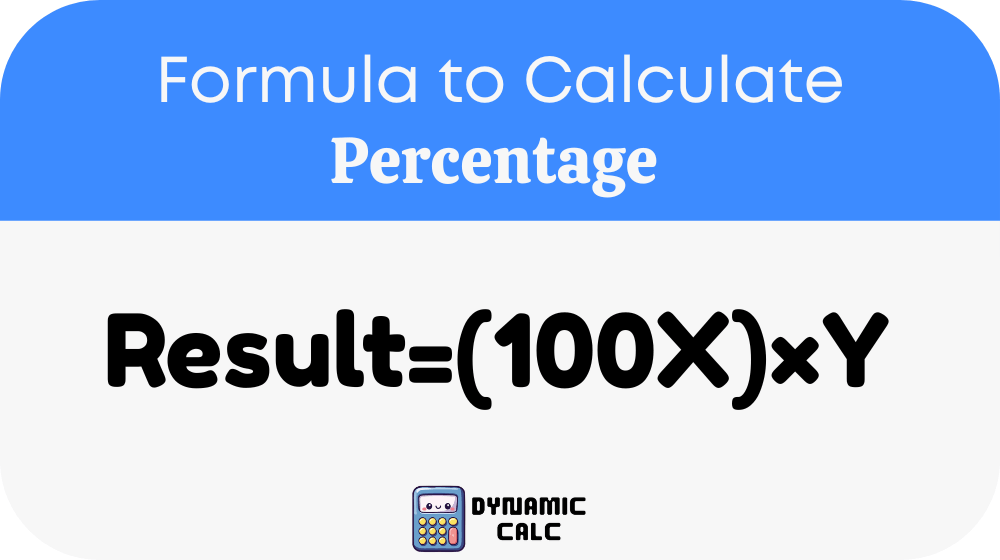
Result=(X100)×Y\text{Result} = \left(\frac{X}{100}\right) \times Y
Where:
- Result = Final calculated value
- X = Percentage value
- Y = Total or base number
Variable Explanation
| Variable | Description | Example |
|---|---|---|
| X | Percentage rate | 25% |
| Y | Base value or total amount | 200 |
| Result | Calculated percentage amount | 50 |
For instance, calculating 25% of 200 gives:
(25 ÷ 100) × 200 = 50
Therefore, 25% of 200 equals 50.
Common Percentage Calculations Reference Table
| Common Search Query | Formula | Result |
|---|---|---|
| 10% of 100 | (10 ÷ 100) × 100 | 10 |
| 15% of 500 | (15 ÷ 100) × 500 | 75 |
| 20% discount on 250 | 250 − 20% of 250 | 200 |
| 25% of 1000 | (25 ÷ 100) × 1000 | 250 |
| 30% increase from 200 | 200 + 30% of 200 | 260 |
| 50% of 80 | (50 ÷ 100) × 80 | 40 |
| 75% of 400 | (75 ÷ 100) × 400 | 300 |
| Percentage increase from 50 to 70 | ((70−50) ÷ 50) × 100 | 40% |
| Percentage decrease from 120 to 90 | ((120−90) ÷ 120) × 100 | 25% |
| Convert fraction 3/4 to percentage | (3 ÷ 4) × 100 | 75% |
| VAT calculation at 18% on 1000 | 1000 + 18% of 1000 | 1180 |
| Exam score percentage for 450/500 | (450 ÷ 500) × 100 | 90% |
Example
Suppose a store offers a 20% discount on a product priced at 500.
First, calculate the discount amount:
(20100)×500=100\left(\frac{20}{100}\right) \times 500 = 100(10020)×500=100
Next, subtract the discount from the original price:
500 − 100 = 400
Therefore, the final product price after applying the 20% discount is 400.
This example demonstrates how percentage calculators simplify shopping calculations and help consumers make informed purchasing decisions quickly and accurately.
Applications
Percentage calculators serve multiple industries and daily activities because percentages simplify numerical analysis and comparison. These calculators improve efficiency, accuracy, and consistency across different sectors.
Financial Calculations
Banks, accountants, and investors use percentage calculators to compute interest rates, profit margins, tax values, inflation rates, and loan repayments. Businesses also rely on percentages for budgeting, revenue forecasting, and financial performance evaluation. Accurate percentage calculations support informed financial decisions and reduce computational errors.
Educational Purposes
Students and educators frequently use percentage calculators to determine grades, examination scores, attendance percentages, and statistical averages. Furthermore, percentage calculations help learners understand mathematical relationships and improve problem-solving skills in algebra, statistics, and economics.
Retail and Commercial Use
Retail businesses apply percentage calculations for discounts, markups, commissions, and sales analysis. Consumers also benefit from percentage calculators when comparing prices, calculating savings, and evaluating promotional offers. Consequently, these tools improve purchasing decisions and support transparent pricing practices.
Most Common FAQs
What is a percentage calculator used for?
A percentage calculator helps users calculate percentages quickly and accurately for educational, financial, business, and personal purposes. People commonly use it to determine discounts, tax amounts, profit margins, examination scores, and percentage increases or decreases. Since percentages represent values relative to one hundred, they simplify comparisons between quantities. Moreover, percentage calculators reduce manual calculation errors and save time in professional and daily tasks. Many online calculators also provide automated formulas, making them accessible for users with different mathematical skill levels and improving efficiency in data interpretation and financial planning.
How do you calculate the percentage of a number?
To calculate the percentage of a number, divide the percentage value by 100 and multiply the result by the total number. This method follows the standard percentage formula used in mathematics and finance. For example, to find 30% of 200, divide 30 by 100 and multiply by 200, resulting in 60. Percentage calculators automate this process and provide immediate results. In addition, they help users avoid arithmetic mistakes when handling large numbers, business reports, tax calculations, or academic assessments that require precise percentage-based computations.
Why are percentage calculations important in finance?
Percentage calculations play a critical role in finance because they measure growth, profitability, risk, taxation, and investment returns. Financial institutions use percentages to calculate loan interest, savings growth, annual returns, and inflation rates. Investors also analyze percentage changes to compare market performance and evaluate financial opportunities. Furthermore, businesses rely on percentages to monitor profit margins, operational efficiency, and sales performance. Since financial decisions often involve precise numerical analysis, percentage calculators improve accuracy and support reliable planning, forecasting, and budgeting processes for both organizations and individuals.