The Functional Gait Assessment Calculator is a structured clinical scoring system designed to assess postural stability during walking tasks of varying difficulty. It evaluates an individual’s ability to maintain balance while performing real-world gait activities such as turning, stepping over obstacles, and walking with head movements. Each task is scored based on performance quality and stability. The total score helps determine the level of mobility impairment and fall risk. This tool is especially important in neurorehabilitation for conditions like stroke, Parkinson’s disease, and vestibular disorders. Consequently, it provides a standardized and evidence-based method for assessing functional walking ability.
Detailed explanations of the calculator's working
The Functional Gait Assessment Calculator works by evaluating performance across 10 predefined walking tasks. Each task is individually scored from 0 to 3 based on observed stability, with 0 indicating severe impairment and 3 representing normal performance. The evaluator observes the patient performing tasks such as walking at different speeds, turning the head, stepping over obstacles, and pivoting. Each score is then added to produce a total FGA score. The maximum achievable score is 30. Higher scores indicate better gait stability and lower fall risk, while lower scores suggest balance impairment. Transitioning between tasks helps assess dynamic balance under real-life conditions, making the results clinically meaningful and reliable for rehabilitation planning.
Formula with variables description (UTF-8 plaintext format)
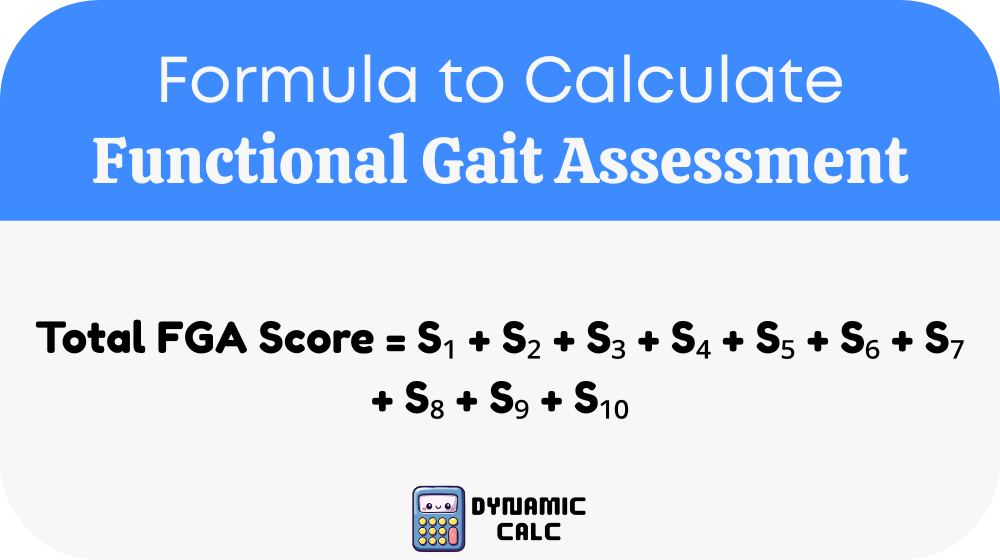
Where:
S₁ = Gait on level surface
S₂ = Change in gait speed
S₃ = Gait with horizontal head turns
S₄ = Gait with vertical head turns
S₅ = Gait and pivot turn
S₆ = Step over obstacle
S₇ = Gait with narrow base of support
S₈ = Gait with eyes closed
S₉ = Ambulating backward
S₁₀ = Stair climbing
Each component is scored from 0 (severe impairment) to 3 (normal function).
Interpretation Table for FGA Scores
| Total Score Range | Interpretation | Clinical Meaning |
|---|---|---|
| 0 – 9 | Severe impairment | Very high fall risk |
| 10 – 15 | Moderate impairment | High fall risk |
| 16 – 22 | Mild impairment | Moderate fall risk |
| 23 – 30 | Normal function | Low fall risk |
This table helps clinicians quickly interpret patient mobility levels without repeated manual analysis, improving workflow efficiency in rehabilitation settings.
Example
A patient performs all 10 tasks with the following scores:
S₁=2, S₂=2, S₃=1, S₄=2, S₅=2, S₆=1, S₇=2, S₈=1, S₉=2, S₁₀=2
Total FGA Score = 2+2+1+2+2+1+2+1+2+2 = 17
A score of 17 indicates mild impairment and suggests a moderate fall risk. Therefore, targeted physiotherapy focusing on balance training, obstacle navigation, and head movement coordination is recommended to improve functional gait performance.
Applications with subheadings
Neurological Rehabilitation
The Functional Gait Assessment Calculator is widely used in neurological rehabilitation for patients recovering from stroke, Parkinson’s disease, or traumatic brain injury. It helps clinicians measure gait stability improvements over time and adjust therapy plans accordingly. Moreover, it highlights specific movement deficits that require targeted intervention.
Elderly Fall Risk Assessment
In geriatric care, this calculator is essential for identifying older adults at risk of falls. Since aging affects balance and coordination, the tool provides early warnings that help prevent injuries through preventive care strategies.
Physiotherapy Progress Tracking
Physiotherapists use FGA scoring to track patient recovery progress. By comparing scores over multiple sessions, they can evaluate the effectiveness of rehabilitation programs and modify exercises for better outcomes.
Most Common FAQs
1. What is the purpose of the Functional Gait Assessment Calculator?
The Functional Gait Assessment Calculator is designed to measure an individual’s walking balance and stability during dynamic movement tasks. Its primary purpose is to identify gait impairments and assess fall risk in patients with neurological, orthopedic, or age-related mobility issues. By providing a standardized scoring system, it allows healthcare professionals to objectively evaluate functional walking ability and track changes over time. This helps in designing appropriate rehabilitation strategies and improving patient safety in clinical and home environments.
2. How is the FGA score calculated accurately?
The FGA score is calculated by summing the individual scores of 10 gait-related tasks, each rated from 0 to 3 based on performance quality. The maximum possible score is 30. A higher score indicates better balance and walking ability, while a lower score reflects greater impairment. Accuracy depends on proper observation by trained clinicians who evaluate real-time movement performance. Therefore, consistency in testing conditions is essential for reliable results across different assessment sessions.
3. Who should use the Functional Gait Assessment Calculator?
This calculator should be used by healthcare professionals such as physiotherapists, neurologists, occupational therapists, and rehabilitation specialists. It is especially useful for patients with balance disorders, neurological conditions, or post-surgical recovery needs. Additionally, it is commonly applied in elderly care settings to evaluate fall risk. Because it is a clinical assessment tool, it requires professional interpretation to ensure accurate diagnosis and treatment planning. It is not intended for self-assessment without medical supervision.