The Rate Spread Calculator is a financial computation tool designed to determine the gap between a mortgage loan’s APR and the APOR published by financial authorities. APR represents the total cost of borrowing expressed as a percentage, while APOR is a benchmark rate derived from average prime mortgage offers in the market. By calculating this spread, lenders and regulators can identify whether a loan falls within standard pricing or exceeds high-cost lending thresholds. Consequently, this calculator is widely used in compliance reporting, loan underwriting, and consumer protection frameworks within mortgage finance systems.
Detailed Explanation of the Calculator’s Working
The Rate Spread Calculator works by taking two key inputs: the loan’s Annual Percentage Rate (APR) and the Average Prime Offer Rate (APOR) for a similar mortgage type. First, the system collects the APR from the loan agreement, which includes interest rate and associated loan costs. Next, it retrieves the APOR value, which is published periodically and reflects average market mortgage rates. Then, the calculator subtracts APOR from APR to determine the rate spread. A positive result indicates a higher-than-market-cost loan, while a lower or negative value suggests competitive pricing. This output helps lenders assess compliance with regulatory lending thresholds and supports borrowers in understanding loan affordability compared to market standards.
Formula with Variables Description
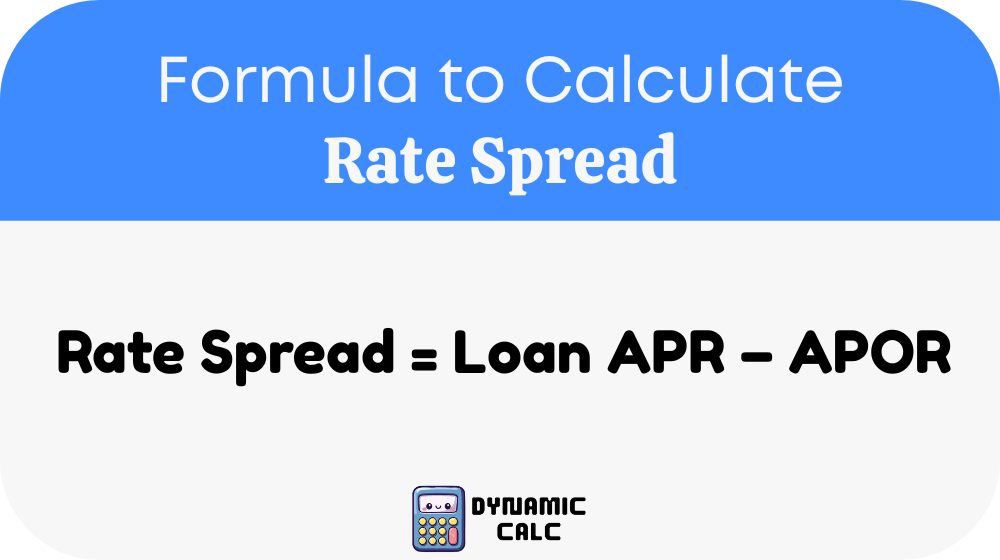
Where:
Loan APR is the Annual Percentage Rate of the loan (expressed as a percentage).
APOR is the Average Prime Offer Rate for a comparable mortgage (fixed or adjustable rate).
This formula helps determine how far a mortgage loan deviates from standard market pricing benchmarks.
Standard Reference Table for Mortgage Rate Analysis
| Term | Description | Typical Range / Value |
|---|---|---|
| Loan APR | Total annual cost of borrowing including fees | 3% – 12% (varies by credit profile) |
| APOR | Market benchmark mortgage rate | 2% – 8% depending on market conditions |
| Rate Spread | Difference between APR and APOR | -1% to 5%+ |
| High-Cost Threshold | Regulatory limit for expensive loans | Usually APOR + 6% or more |
| Prime Borrower Rate | Lowest available mortgage rate | Typically near APOR |
This table provides quick reference values to help users understand how mortgage pricing compares without repeated manual calculations.
Example
Assume a borrower receives a mortgage loan with an APR of 7.5%, while the APOR for similar loans is 5.0%.
Using the formula:
Rate Spread = 7.5% − 5.0%
Rate Spread = 2.5%
In this case, the loan has a positive spread of 2.5%, meaning it is priced above the market benchmark. This indicates that the loan may be moderately higher in cost compared to average prime mortgage offers. Such an outcome may require further review by lenders or financial advisors to ensure it aligns with borrower affordability standards and regulatory requirements.
Applications in Real-World Lending Decisions
Mortgage Qualification Analysis
The Rate Spread Calculator is widely used to evaluate whether a borrower qualifies for standard mortgage products. By comparing APR with APOR, lenders can quickly assess if a loan is within acceptable market ranges. This ensures borrowers are not overcharged and helps financial institutions maintain transparent pricing structures.
Regulatory Compliance Checks
Financial regulators use rate spread calculations to determine whether a loan should be classified as a high-cost mortgage. If the spread exceeds defined thresholds, additional disclosures and protections may be required. This supports fair lending practices and reduces the risk of predatory lending in the mortgage industry.
Borrower Risk Assessment
Lenders also use the rate spread to analyze borrower risk levels. A higher spread may indicate increased credit risk or higher loan costs. Conversely, a lower spread suggests strong creditworthiness and favorable loan terms. This helps lenders design better risk-based pricing models for mortgage products.
Most Common FAQs
1. What is a Rate Spread Calculator used for?
The Rate Spread Calculator is used to measure the difference between a loan’s APR and the APOR benchmark rate. It helps lenders, regulators, and borrowers understand how a mortgage compares to standard market pricing. This calculation is essential in identifying high-cost loans and ensuring compliance with financial regulations. It also supports transparency in lending by clearly showing whether a loan is priced fairly or above average market levels.
2. Why is APOR important in mortgage calculations?
APOR, or Average Prime Offer Rate, is important because it acts as a benchmark for mortgage pricing. It represents average interest rates offered to highly qualified borrowers in the market. By comparing APR to APOR, financial institutions can determine whether a loan is competitively priced. This comparison is crucial for regulatory reporting and helps protect borrowers from excessively high lending costs.
3. What does a high rate spread mean?
A high rate spread means that the loan’s APR is significantly higher than the APOR. This usually indicates that the loan is more expensive than standard market offerings. It may reflect higher borrower risk, lower credit scores, or unfavorable loan terms. In regulatory terms, a high spread can classify the loan as a high-cost mortgage, which may require additional disclosures and consumer protections.