Imputed income refers to the taxable value of non-cash benefits that an employer provides to an employee. Although the employee does not receive these benefits as direct cash payments, tax regulations often require their value to be included in taxable income.
Examples of benefits that may generate imputed income include employer-paid life insurance exceeding allowable limits, company vehicles used for personal purposes, employer-provided housing, below-market interest loans, and personal use of company assets.
An Imputed Income Calculator estimates the fair market value (FMV) of these benefits and determines the amount that must be reported as taxable income. Consequently, employers can accurately withhold taxes and comply with payroll reporting requirements.
Detailed Explanation of the Calculator’s Working
An Imputed Income Calculator evaluates the fair market value of employer-provided benefits and compares it with any amount paid by the employee. The difference represents taxable imputed income.
First, the calculator identifies the specific benefit type, such as life insurance, vehicle usage, housing, or loans. Next, it determines the fair market value using appropriate valuation methods. Afterward, it subtracts any employee contributions or payments toward the benefit.
For specialized benefits, such as group-term life insurance or below-market loans, the calculator applies tax-specific formulas and valuation tables. Finally, it combines the taxable value of all applicable benefits to determine total annual imputed income.
This process helps employers maintain accurate payroll records while allowing employees to understand the tax implications of employer-provided benefits.
Formula with Variables Description
General Imputed Income Formula

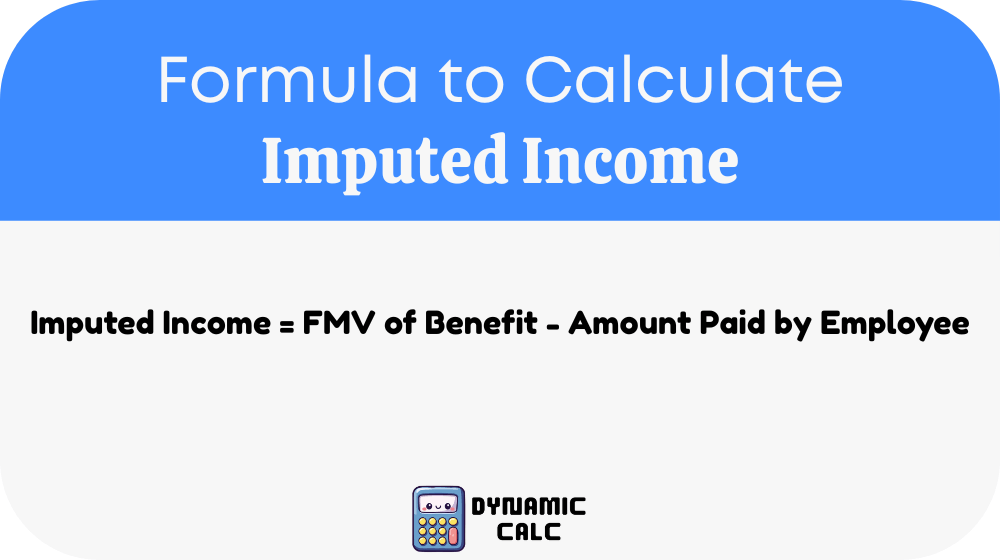
Where:
| Variable | Description |
|---|---|
| Imputed Income | Taxable value added to employee income |
| FMV of Benefit | Fair Market Value of the provided benefit |
| Amount Paid by Employee | Employee contribution toward the benefit |
FMV of Benefit Determination
FMV of Benefit =

Standard Valuation Table Value
OR
Interest Rate Differential × Loan Principal × Time Period
OR
Cost to Employer × Personal Use Percentage
Group-Term Life Insurance Formula
Imputed Income =
(Coverage Amount - 50000)
× IRS Table Rate (per $1000)
× 12
× Employee Age Factor
Variables:
| Variable | Description |
|---|---|
| Coverage Amount | Total employer-provided life insurance coverage |
| 50000 | Tax-free coverage threshold |
| IRS Table Rate | Monthly taxable cost per $1,000 coverage |
| 12 | Number of months in a year |
| Employee Age Factor | Rate determined by employee age |
Below-Market Loan Formula
Imputed Interest =
(AFR - Actual Interest Rate)
× Outstanding Principal
× (Number of Days / 365)
Variables:
| Variable | Description |
|---|---|
| AFR | Applicable Federal Rate |
| Actual Interest Rate | Interest charged by employer |
| Outstanding Principal | Remaining loan balance |
| Number of Days | Loan duration during the tax year |
Company Vehicle Personal Use Formula
Imputed Income =
Annual Lease Value
× Personal Use Percentage
Variables:
| Variable | Description |
|---|---|
| Annual Lease Value | IRS-assigned annual vehicle value |
| Personal Use Percentage | Percentage of personal vehicle usage |
Total Annual Imputed Income
Total Annual Imputed Income =
Sum of (FMV of Benefit_i - Employee Payment_i)
for all benefits
Quick Reference Table for Common Imputed Income Calculations
| Benefit Type | Typical Taxable Method |
|---|---|
| Company Vehicle | Annual Lease Value × Personal Use % |
| Employer Housing | FMV − Employee Rent Paid |
| Group-Term Life Insurance | Coverage Above $50,000 Rule |
| Below-Market Loan | AFR Differential Method |
| Personal Use of Equipment | Employer Cost × Personal Use % |
| Gym Membership | FMV − Employee Contribution |
| Employer-Paid Education | Taxability Depends on Regulations |
| Relocation Benefits | FMV of Benefit Received |
| Company Phone Personal Use | May Be Excluded in Certain Cases |
| Employee Discounts | Taxable Above Allowed Limits |
Common Percentage to Decimal Conversion Table
| Percentage | Decimal |
|---|---|
| 5% | 0.05 |
| 10% | 0.10 |
| 15% | 0.15 |
| 20% | 0.20 |
| 25% | 0.25 |
| 30% | 0.30 |
| 40% | 0.40 |
| 50% | 0.50 |
| 75% | 0.75 |
| 100% | 1.00 |
Example
Suppose an employee receives a company vehicle with an annual lease value of $8,000. Records show that 30% of the vehicle usage is personal.
Using the formula:
Imputed Income =
Annual Lease Value × Personal Use Percentage
Substitute the values:
Imputed Income =
8000 × 0.30
Result:
Imputed Income = $2,400
Therefore, the employer must include $2,400 as taxable income for the employee during the tax year.
If the employee pays $400 toward personal vehicle use:
Imputed Income =
2400 − 400
Final taxable imputed income:
Imputed Income = $2,000
Applications
Payroll and Tax Compliance
Organizations use imputed income calculations to maintain accurate payroll reporting and tax withholding. Proper calculations help employers comply with tax regulations and avoid penalties associated with underreporting employee compensation.
Employee Benefits Administration
Human resource departments rely on imputed income calculations when administering life insurance, housing benefits, company vehicles, and employee assistance programs. Accurate calculations improve transparency and help employees understand the tax consequences of workplace benefits.
Financial Planning and Compensation Analysis
Employees and financial advisors use imputed income estimates to assess total compensation packages. By understanding the taxable value of employer-provided benefits, individuals can make better budgeting, tax planning, and compensation decisions.
Most Common FAQs
What is considered imputed income?
Imputed income includes the taxable value of benefits provided by an employer that are not received as direct cash wages. Examples include employer-paid life insurance above allowable limits, personal use of company vehicles, below-market loans, housing assistance, and personal use of company assets. Tax authorities generally require employers to include these benefits in taxable income calculations because they provide measurable financial value to employees.
Why is imputed income taxed?
Tax authorities tax imputed income because non-cash benefits provide economic value similar to cash compensation. Without taxation, employees receiving substantial fringe benefits could gain an unfair tax advantage compared with employees receiving equivalent compensation in wages. Therefore, tax regulations require employers to determine the fair market value of certain benefits and include that value in taxable income calculations.
How does group-term life insurance create imputed income?
Employer-provided group-term life insurance coverage exceeding $50,000 may generate taxable imputed income. Tax regulations generally allow the first $50,000 of coverage to remain tax-free. However, coverage above that threshold creates a taxable benefit. Payroll departments calculate the taxable amount using government-approved rate tables that consider the employee’s age and coverage amount.