Feet of head refers to the height of a liquid column that produces pressure at its base due to gravity. PSI (pounds per square inch) is a unit of pressure commonly used in engineering and industrial applications. The Feet of Head to PSI Calculator converts the vertical height of a fluid column into equivalent pressure in PSI. This conversion is essential in fluid mechanics because it connects gravitational force, fluid density, and pressure measurement. Consequently, it helps standardize pressure values across different systems and industries.
Detailed Explanation of the Calculator’s Working
The Feet of Head to PSI Calculator works based on hydrostatic pressure principles. When a fluid column rises in height, it exerts pressure at the base due to gravitational force acting on its mass. The calculator takes the height of the fluid in feet and converts it into pressure using a fixed conversion constant derived from water density and gravitational acceleration. Additionally, it may consider specific gravity for different fluids. By multiplying head height with the conversion factor, it quickly produces PSI values without requiring manual physics calculations or complex unit conversions.
Formula with Variables Description
Formula
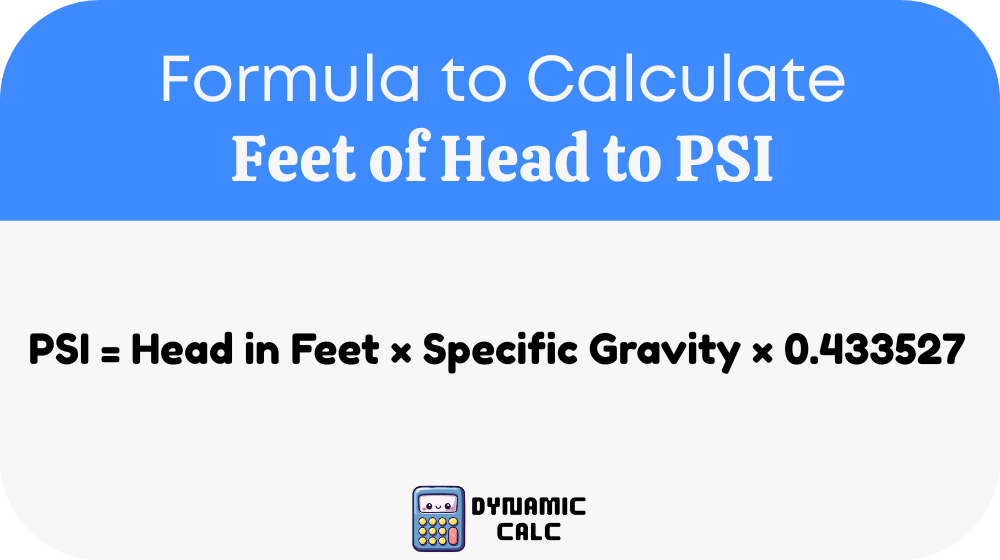
For highest accuracy with water at standard conditions (Specific Gravity = 1.0):
PSI = Head in Feet × 0.433527
More detailed precise version:
PSI = (Head in Feet × 62.428 × 32.174049) / 144 utf-8 plaintext format
Variables Description:
- PSI = Pressure in pounds per square inch
- Head in Feet = Height of fluid column measured in feet
- Specific Gravity = Ratio of fluid density compared to water
- 62.428 = Weight density of water (lb/ft³)
- 32.174049 = Gravitational acceleration (ft/s²)
- 144 = Conversion factor from square feet to square inches
Quick Conversion Table
| Feet of Head | PSI (Approx.) |
|---|---|
| 1 ft | 0.433 PSI |
| 5 ft | 2.17 PSI |
| 10 ft | 4.34 PSI |
| 25 ft | 10.84 PSI |
| 50 ft | 21.68 PSI |
| 100 ft | 43.35 PSI |
| This table helps users quickly estimate pressure without performing manual calculations, especially useful in fieldwork and quick engineering assessments. |
Example
If a water tank has a height of 30 feet, the pressure at the base can be calculated using the standard formula: PSI = 30 × 0.433527 PSI ≈ 13.0058 PSI This means that a 30-foot column of water generates approximately 13 PSI at its base under standard conditions. Such calculations are essential when designing pipelines, pumps, or storage tanks to ensure they can handle expected pressure loads safely.
Applications
Plumbing Systems
In plumbing systems, this conversion helps determine water pressure in residential and commercial buildings. Engineers use it to ensure proper water flow to upper floors. Incorrect pressure estimation can lead to weak flow or pipe damage, making accurate conversion critical for system safety and efficiency.
Hydraulic Engineering
Hydraulic engineers use Feet of Head to PSI conversion to design dams, canals, and fluid transport systems. It helps in analyzing how water pressure changes with elevation, ensuring structures can withstand operational stress without failure or leakage.
Water Pump Design
Pump manufacturers and technicians rely on this conversion to select appropriate pumps for specific head requirements. It ensures pumps generate enough pressure to move water efficiently through pipelines, irrigation systems, and industrial fluid networks without energy loss.
Most Common FAQs
1. Why is Feet of Head used instead of PSI in some systems?
Feet of head is often used because it directly represents the height of a fluid column, which is easier to visualize in gravitational systems. Engineers prefer it in water distribution and pumping systems since it naturally relates to elevation differences. PSI, on the other hand, is more common in mechanical and industrial pressure systems.
2. Does fluid type affect the conversion?
Yes, fluid type significantly affects the conversion. Different fluids have different densities, which means their specific gravity changes. Heavier fluids produce more pressure at the same height compared to lighter fluids. That is why the specific gravity factor is included in the formula to ensure accurate conversion across various liquids.
3. Can this calculator be used for gases?
This calculator is mainly designed for liquids, especially incompressible fluids like water. Gases behave differently because they are compressible and their density changes with pressure and temperature. Therefore, while basic approximations can be made, specialized gas equations are required for accurate gas pressure calculations.