An EMI Calculator is a digital financial tool that calculates the Equated Monthly Installment (EMI) payable on a loan amount over a fixed repayment period. The calculator uses three primary variables: principal loan amount, interest rate, and loan tenure.
An EMI consists of both principal repayment and interest payment. Initially, the interest portion remains higher, while the principal repayment gradually increases during the loan tenure. Furthermore, the EMI amount usually remains fixed throughout the repayment period unless the lender changes the interest structure.
Financial institutions widely use EMI calculations for home loans, car loans, personal loans, education loans, and business financing. Consequently, the calculator helps borrowers evaluate affordability, compare lending options, and understand long-term repayment obligations before signing any loan agreement.
Detailed Explanations of the Calculator’s Working
An EMI Calculator works by applying a standard mathematical formula that combines compound interest principles with monthly repayment schedules. First, the user enters the loan amount, annual interest rate, and repayment tenure in months or years. Then, the calculator converts the annual interest rate into a monthly rate and applies it to the formula.
The system calculates the fixed monthly installment required to repay the entire loan amount within the selected period. Additionally, the calculator divides each EMI into interest and principal components. Early installments contain a larger interest portion, while later installments repay more principal.
Modern EMI calculators also provide amortization schedules, total interest payable, and total repayment values. Therefore, borrowers can analyze long-term financial commitments accurately and make informed borrowing decisions.
Formula with Variables Description

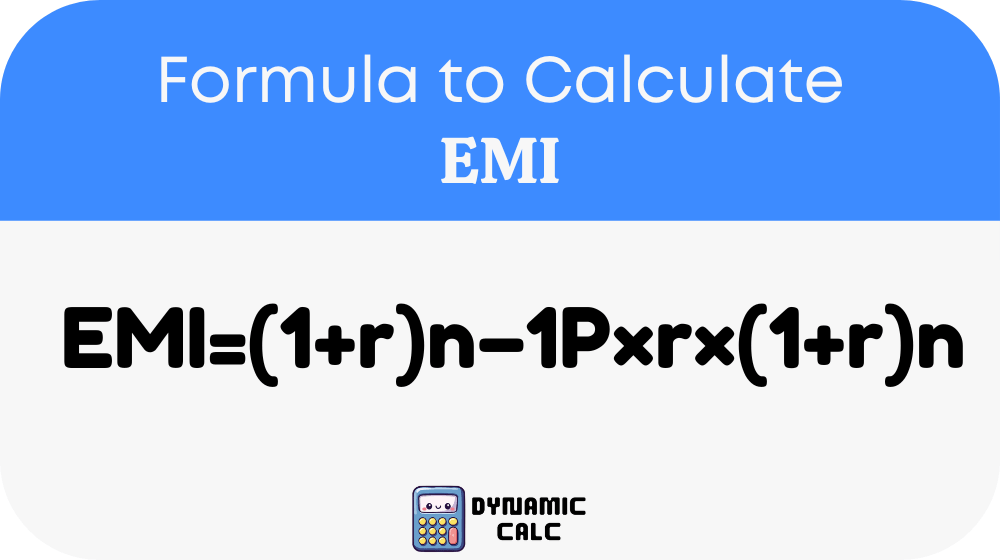
Where:
- EMI = Equated Monthly Installment
- P = Principal loan amount
- r = Monthly interest rate (Annual Interest Rate ÷ 12 ÷ 100)
- n = Total number of monthly installments
- (1 + r)^n = Compound interest factor based on loan tenure
Important Notes About Variables
- Higher principal amounts increase EMI values.
- Higher interest rates significantly increase total repayment cost.
- Longer tenures reduce monthly EMI but increase total interest paid.
- Shorter tenures increase EMI but reduce overall borrowing cost.
Common EMI Values Reference Table
| Loan Amount | Interest Rate | Tenure | Approximate EMI |
|---|---|---|---|
| $5,000 | 8% | 1 Year | $435 |
| $10,000 | 10% | 2 Years | $461 |
| $20,000 | 9% | 3 Years | $636 |
| $50,000 | 11% | 5 Years | $1,087 |
| $100,000 | 7% | 10 Years | $1,161 |
| $200,000 | 6.5% | 20 Years | $1,491 |
| $300,000 | 7.5% | 30 Years | $2,098 |
Monthly Interest Rate Conversion Table
| Annual Interest Rate | Monthly Interest Rate |
|---|---|
| 6% | 0.50% |
| 8% | 0.67% |
| 10% | 0.83% |
| 12% | 1.00% |
| 15% | 1.25% |
Loan Tenure Conversion Table
| Years | Months |
|---|---|
| 1 Year | 12 Months |
| 3 Years | 36 Months |
| 5 Years | 60 Months |
| 10 Years | 120 Months |
| 20 Years | 240 Months |
| 30 Years | 360 Months |
Example
Suppose a borrower takes a loan of $50,000 at an annual interest rate of 10% for 5 years.
Step 1: Convert annual interest rate into monthly rate.
Monthly Interest Rate = 10 ÷ 12 ÷ 100
Monthly Interest Rate = 0.00833
Step 2: Determine total monthly installments.
Loan Tenure = 5 years
Total Installments = 5 × 12 = 60
Step 3: Apply the EMI formula.
EMI=50000×0.00833×(1+0.00833)60(1+0.00833)60−1EMI = \frac{50000 \times 0.00833 \times (1+0.00833)^{60}}{(1+0.00833)^{60}-1}EMI=(1+0.00833)60−150000×0.00833×(1+0.00833)60
Approximate EMI = $1,062
Therefore, the borrower must pay approximately $1,062 every month for 60 months. Additionally, the total repayment amount will exceed the original loan amount because of accumulated interest charges.
Applications
EMI Calculators support financial planning across multiple industries and personal finance activities. Furthermore, they improve transparency and repayment awareness before loan approval.
Home Loan Planning
Home buyers use EMI calculators to estimate affordable property budgets and monthly repayment obligations. Consequently, they can compare different loan tenures and interest rates before selecting a mortgage provider.
Vehicle Financing
Car and motorcycle buyers use EMI calculations to determine manageable monthly installments. Moreover, dealerships frequently integrate EMI tools into financing systems to improve customer decision-making.
Personal and Education Loans
Students and salaried professionals rely on EMI calculators to evaluate repayment capacity for education loans and personal financing. Therefore, borrowers can balance future expenses while avoiding excessive financial pressure.
Most Common FAQs
What is the main purpose of an EMI Calculator?
An EMI Calculator helps borrowers estimate their monthly loan repayments accurately before applying for financing. It allows users to compare loan options, interest rates, and repayment periods quickly. Additionally, the calculator improves budgeting because borrowers can determine whether a particular loan fits their financial situation. Financial institutions, banks, and online lenders widely use EMI calculators to provide repayment transparency and simplify loan planning for customers seeking mortgages, personal loans, or vehicle financing.
Does a longer loan tenure reduce EMI payments?
Yes, extending the loan tenure generally reduces monthly EMI payments because the repayment amount spreads across more months. However, longer repayment periods also increase the total interest paid during the loan term. Therefore, borrowers should balance affordability with overall borrowing costs. A shorter tenure increases monthly payments but reduces total interest expenses significantly. Consequently, an EMI Calculator helps borrowers compare multiple tenure options and choose the most financially efficient repayment strategy.
Can EMI amounts change during the loan period?
EMI amounts usually remain fixed for loans with fixed interest rates. However, floating or variable interest rate loans may experience EMI changes when market interest rates fluctuate. In such cases, lenders may either adjust the EMI amount or extend the repayment tenure. Therefore, borrowers should carefully review loan agreements and interest structures before accepting financing. EMI calculators often support both fixed-rate and floating-rate estimates for more accurate financial planning.