A dB to dBm Calculator is a digital conversion tool that calculates power levels in dBm based on decibel measurements and a known reference power level. While dB represents a relative ratio between two power values, dBm expresses an absolute power level relative to 1 milliwatt (mW).
The calculator eliminates manual logarithmic calculations and reduces the possibility of errors. Users commonly utilize it in wireless communication systems, RF engineering, satellite communications, cellular networks, audio engineering, and electronic testing environments.
Because dBm provides a standardized power reference, professionals can compare signal strengths consistently across different devices and communication systems.
Detailed Explanation of the Calculator's Working
The dB to dBm Calculator operates using logarithmic mathematics. First, it requires a power value measured relative to a reference point. Then, it converts that value into an absolute power level expressed in dBm.
When power is greater than 1 milliwatt, the resulting dBm value becomes positive. Conversely, when power falls below 1 milliwatt, the dBm value becomes negative. The calculator applies a logarithmic base-10 function to determine the exact relationship between power and the 1 mW reference.
Furthermore, the tool automatically handles large ranges of signal strengths, making it ideal for RF systems, wireless networks, antenna design, and communication equipment testing where power levels often vary significantly.
Formula with Variables Description
Formula:
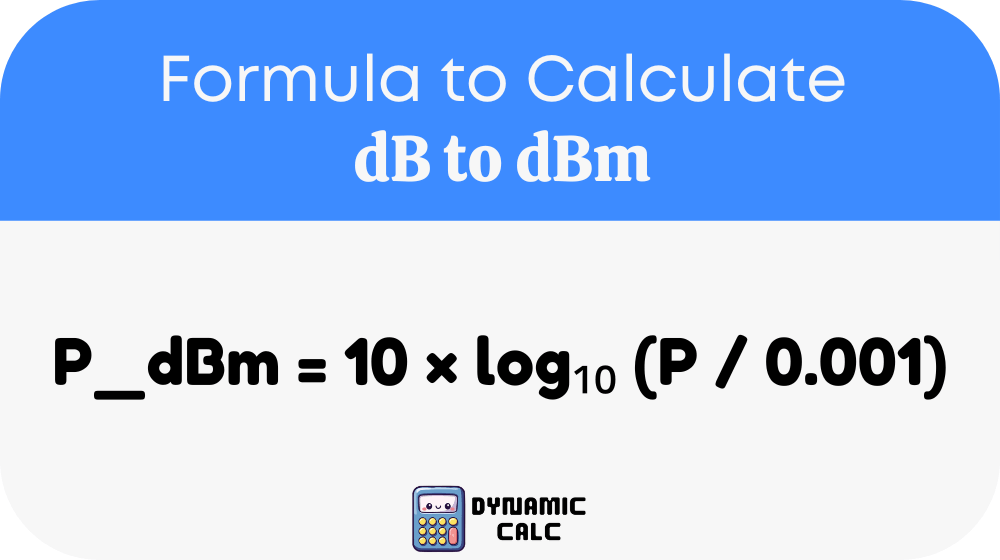
Where:
- P_dBm = Power level in decibel-milliwatts (dBm)
- P = Power in watts (W)
- log₁₀ = Base-10 logarithm
- 0.001 = Reference power equal to 1 milliwatt (1 mW)
This formula converts an absolute power value measured in watts into dBm by comparing it against the standard 1 milliwatt reference.
Common dB, Watt, and dBm Conversion Reference Table
| Power (W) | Power (mW) | dBm |
|---|---|---|
| 0.000001 | 0.001 | -30 dBm |
| 0.00001 | 0.01 | -20 dBm |
| 0.0001 | 0.1 | -10 dBm |
| 0.001 | 1 | 0 dBm |
| 0.002 | 2 | 3 dBm |
| 0.005 | 5 | 7 dBm |
| 0.01 | 10 | 10 dBm |
| 0.05 | 50 | 17 dBm |
| 0.1 | 100 | 20 dBm |
| 0.5 | 500 | 27 dBm |
| 1 | 1000 | 30 dBm |
| 2 | 2000 | 33 dBm |
| 5 | 5000 | 37 dBm |
| 10 | 10000 | 40 dBm |
| 100 | 100000 | 50 dBm |
This table provides quick reference values that users frequently search for when evaluating signal power levels.
Example
Suppose a transmitter outputs:
Power (P) = 0.05 W
Using the formula:
P_dBm = 10 × log₁₀ (0.05 / 0.001)
P_dBm = 10 × log₁₀ (50)
P_dBm = 10 × 1.699
P_dBm = 16.99 dBm
Result:
0.05 watts ≈ 17 dBm
Therefore, a transmitter producing 50 milliwatts of power generates approximately 17 dBm.
Applications
Wireless Network Engineering
Network engineers use dBm measurements to evaluate Wi-Fi signal strength, optimize access point placement, and improve wireless coverage. Accurate conversions help identify weak signal areas and enhance network reliability.
Radio Frequency (RF) Systems
RF engineers frequently analyze transmitter output power, antenna gain, cable losses, and receiver sensitivity using dBm values. Consequently, accurate conversion ensures proper system design and performance verification.
Telecommunications and Cellular Networks
Cellular providers rely on dBm measurements to monitor signal quality, maintain network performance, and troubleshoot communication issues. The calculator enables quick conversion of power values for efficient network management.
Most Common FAQs
What is the difference between dB and dBm?
The primary difference is that dB measures a relative ratio between two values, whereas dBm measures an absolute power level referenced to 1 milliwatt. Engineers use dB to express gain, attenuation, or signal loss. In contrast, dBm indicates the actual signal power being transmitted or received. Understanding this distinction is essential because communication systems often require both relative and absolute measurements for accurate performance analysis and troubleshooting.
Why are dBm values sometimes negative?
Negative dBm values occur when the measured power level is less than 1 milliwatt. For example, 0 dBm equals exactly 1 mW. Any power lower than 1 mW produces a negative dBm value. This does not indicate an error or invalid measurement. Instead, it reflects extremely low power levels commonly found in wireless receivers, mobile devices, GPS systems, and sensitive communication equipment where signals can be significantly weaker than 1 mW.
Where is dBm commonly used?
dBm is widely used in telecommunications, Wi-Fi networks, cellular systems, radio communications, satellite networks, broadcasting equipment, and RF engineering. Professionals use dBm because it provides a standardized method for comparing signal strengths across different devices and technologies. Since communication systems often operate across large power ranges, the logarithmic dBm scale simplifies calculations and enables more efficient analysis of signal performance and network quality.