A Hertz to Seconds Calculator helps users convert frequency values measured in Hertz (Hz) into time periods measured in seconds (s). This conversion plays a vital role in physics, electronics, telecommunications, signal processing, acoustics, and engineering applications. Since frequency and time period share an inverse relationship, understanding this conversion allows professionals, students, and researchers to analyze repeating events more effectively.
Moreover, manual calculations can become time-consuming when working with multiple frequencies. Therefore, a Hertz to Seconds Calculator simplifies the process and provides instant, accurate results. Whether you work with electrical signals, sound waves, or mechanical systems, this calculator serves as a practical tool for everyday calculations.
Definition
A Hertz to Seconds Calculator is a conversion tool that determines the period of a repeating event based on its frequency. Hertz represents the number of cycles that occur in one second, while seconds represent the duration of a single cycle.
For example, a frequency of 10 Hz means that ten complete cycles occur every second. Consequently, each cycle lasts 0.1 seconds. The calculator automatically applies the mathematical relationship between frequency and period to generate accurate results.
Because frequency and period are inversely proportional, higher frequencies result in shorter periods, whereas lower frequencies produce longer periods. This principle forms the foundation of many scientific and engineering calculations.
Detailed Explanation of the Calculator's Working
The Hertz to Seconds Calculator works by applying a simple inverse relationship between frequency and time period. Users enter a frequency value in Hertz, and the calculator instantly computes the duration of one cycle in seconds.
First, the calculator accepts the frequency input. Next, it divides the number one by the entered frequency value. The resulting output represents the period of a single cycle.
For instance, if the frequency equals 50 Hz, the calculator performs the following operation:
1 ÷ 50 = 0.02 seconds
As a result, one complete cycle takes 0.02 seconds to occur. Additionally, the calculator minimizes human error and improves efficiency when handling large datasets, laboratory measurements, engineering designs, and educational exercises.
Formula with Variables Description
Hertz to Seconds conversion uses the following formula:
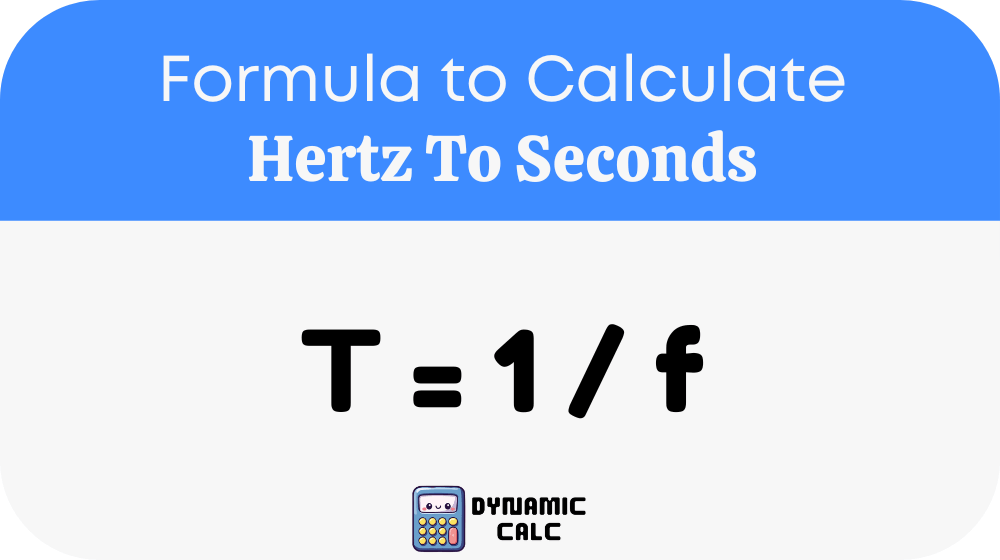
Where:
T = Period in seconds (s)
f = Frequency in Hertz (Hz)
Variable Explanation
| Variable | Meaning | Unit |
|---|---|---|
| T | Time period of one cycle | Seconds (s) |
| f | Frequency of repeating event | Hertz (Hz) |
The formula demonstrates that period decreases as frequency increases and vice versa.
Common Hertz to Seconds Conversion Table
The following reference table helps users quickly find commonly used conversions without performing calculations manually.
| Frequency (Hz) | Period (Seconds) |
|---|---|
| 0.1 Hz | 10 s |
| 0.2 Hz | 5 s |
| 0.5 Hz | 2 s |
| 1 Hz | 1 s |
| 2 Hz | 0.5 s |
| 5 Hz | 0.2 s |
| 10 Hz | 0.1 s |
| 20 Hz | 0.05 s |
| 25 Hz | 0.04 s |
| 50 Hz | 0.02 s |
| 60 Hz | 0.01667 s |
| 100 Hz | 0.01 s |
| 500 Hz | 0.002 s |
| 1,000 Hz | 0.001 s |
| 10,000 Hz | 0.0001 s |
| 100,000 Hz | 0.00001 s |
| 1 MHz | 0.000001 s |
| 10 MHz | 0.0000001 s |
Example
Suppose a signal operates at a frequency of 25 Hz.
Using the formula:
T = 1 / f
T = 1 / 25
T = 0.04 seconds
Therefore, one complete cycle takes 0.04 seconds to finish.
Another example involves a frequency of 60 Hz.
T = 1 / 60
T = 0.01667 seconds
Thus, each cycle lasts approximately 16.67 milliseconds.
Applications
Hertz to Seconds conversion serves numerous scientific, technical, and industrial purposes.
Electronics and Electrical Engineering
Engineers frequently convert Hertz to seconds when analyzing alternating current (AC) systems, oscillators, timing circuits, and electronic signals. Understanding the period helps optimize system performance and diagnose signal-related issues.
Telecommunications and Signal Processing
Communication systems rely heavily on frequency analysis. Technicians use period calculations to evaluate transmission timing, digital communication protocols, modulation systems, and network synchronization processes.
Physics and Scientific Research
Scientists study wave behavior, oscillations, vibrations, acoustics, and electromagnetic phenomena using frequency and period measurements. Accurate conversions improve data interpretation and experimental reliability.
Most Common FAQs
What is the relationship between Hertz and seconds?
Hertz and seconds share an inverse relationship. Hertz measures how many cycles occur in one second, whereas seconds measure the duration of a single cycle. As frequency increases, the time required for each cycle decreases. Conversely, when frequency decreases, the cycle duration becomes longer. This relationship forms the basis of the Hertz to Seconds conversion formula and is widely used in physics, electronics, and engineering applications.
Why do engineers convert Hertz to seconds?
Engineers convert Hertz to seconds because many systems operate using repetitive signals and cycles. While frequency indicates how often events occur, the period reveals how long each event lasts. This information helps engineers design circuits, analyze waveforms, synchronize devices, troubleshoot equipment, and optimize performance. Consequently, period calculations provide valuable insights that frequency values alone may not reveal.
Can the Hertz to Seconds formula be used for any frequency?
Yes. The formula T = 1 / f applies universally to any positive frequency value. Whether the frequency is extremely low, such as 0.1 Hz, or extremely high, such as several megahertz, the same mathematical relationship remains valid. However, users should ensure they enter the frequency in Hertz to obtain an accurate period measurement in seconds.