A Micromol/L to mg/dL Calculator is a scientific conversion tool that converts concentrations expressed in micromoles per liter (µmol/L) into milligrams per deciliter (mg/dL). The conversion depends on the molecular weight of the specific substance because different compounds have different masses.
Micromoles per liter measure the number of molecules present in a solution, while milligrams per deciliter measure the mass concentration of that substance. Since laboratory reports may use either unit depending on regional standards or testing methods, conversion tools help users compare values accurately.
This calculator is particularly useful in clinical chemistry, medical diagnostics, pharmaceutical research, and biological sciences where precise concentration measurements are essential.
Detailed Explanation of the Calculator's Working
The calculator converts a molar concentration into a mass concentration. To perform the conversion, it requires two inputs:
- Concentration in micromoles per liter (µmol/L)
- Molecular weight of the substance in grams per mole (g/mol)
The calculator multiplies the concentration value by the molecular weight to determine the corresponding mass. It then applies the appropriate unit conversion factor to express the result in milligrams per deciliter.
Because each substance has a unique molecular weight, the same µmol/L value can produce different mg/dL results. For example, 100 µmol/L of creatinine will convert differently than 100 µmol/L of glucose.
By automating these calculations, the calculator improves accuracy, reduces human error, and provides consistent results for laboratory and clinical applications.
Formula with Variables Description
Formula:
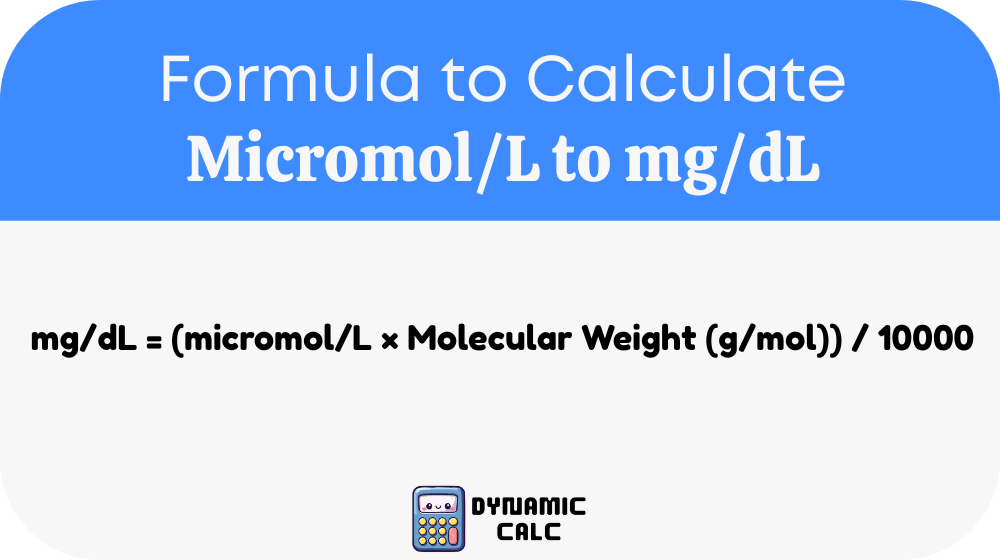
Where:
- mg/dL = Concentration in milligrams per deciliter
- micromol/L = Concentration in micromoles per liter
- Molecular Weight (g/mol) = Molecular mass of the substance
- 10000 = Unit conversion factor used to convert micromolar concentration into mg/dL
This formula ensures accurate conversion between molar concentration and mass concentration measurements.
Common Micromol/L to mg/dL Conversion Reference Table
| Substance | Molecular Weight (g/mol) | µmol/L | Approx. mg/dL |
|---|---|---|---|
| Creatinine | 113.12 | 88.4 | 1.0 |
| Creatinine | 113.12 | 176.8 | 2.0 |
| Creatinine | 113.12 | 265.2 | 3.0 |
| Glucose | 180.16 | 555 | 10.0 |
| Glucose | 180.16 | 1110 | 20.0 |
| Bilirubin | 584.66 | 17.1 | 1.0 |
| Bilirubin | 584.66 | 34.2 | 2.0 |
| Cholesterol | 386.65 | 258.6 | 10.0 |
| Uric Acid | 168.11 | 59.5 | 1.0 |
| Uric Acid | 168.11 | 357 | 6.0 |
Quick Conversion Factors
| Analyte | Conversion Factor |
|---|---|
| Creatinine | mg/dL = µmol/L ÷ 88.4 |
| Bilirubin | mg/dL = µmol/L ÷ 17.1 |
| Glucose | mg/dL = µmol/L ÷ 55.5 |
| Uric Acid | mg/dL = µmol/L ÷ 59.5 |
| Cholesterol | mg/dL = µmol/L ÷ 25.86 |
Example
Suppose a laboratory report shows a creatinine concentration of 150 µmol/L.
Given:
- Micromol/L = 150
- Molecular Weight of Creatinine = 113.12 g/mol
Using the formula:
mg/dL = (150 × 113.12) / 10000
mg/dL = 1.6968
Result:
150 µmol/L of creatinine is approximately equal to 1.70 mg/dL.
This example demonstrates how the calculator converts laboratory values quickly and accurately without requiring manual calculations.
Applications
Clinical Laboratory Testing
Medical laboratories routinely use concentration conversions when reporting blood chemistry results. Physicians often compare results from different laboratories that may use different measurement systems. The calculator helps standardize values for easier interpretation.
Healthcare and Patient Monitoring
Doctors use converted measurements to assess kidney function, liver function, blood glucose levels, and other health indicators. Accurate conversions support better diagnosis and treatment decisions.
Scientific Research and Education
Researchers and students frequently work with biochemical concentrations in different units. The calculator provides a reliable method for converting values during experiments, data analysis, and academic studies.
Most Common FAQs
What is the difference between µmol/L and mg/dL?
Micromoles per liter (µmol/L) measure the number of molecules of a substance within a given volume of solution, while milligrams per deciliter (mg/dL) measure the actual mass of that substance. Because one unit measures quantity and the other measures weight, a molecular weight value is required for conversion. This distinction is particularly important in chemistry, medicine, and laboratory science where concentration measurements must be interpreted accurately.
Why is molecular weight required for the conversion?
Molecular weight determines how much a specific quantity of molecules weighs. Since different substances have different molecular structures and masses, the same concentration in µmol/L will not produce the same mg/dL value. For example, glucose and creatinine have different molecular weights, so their conversion results differ even when their micromolar concentrations are identical. Therefore, molecular weight is an essential part of the calculation.
When should I use a Micromol/L to mg/dL Calculator?
You should use this calculator whenever laboratory results, research data, or scientific measurements need conversion between µmol/L and mg/dL. It is especially useful when reviewing international laboratory reports, comparing historical data, conducting research, or interpreting clinical results. The calculator improves efficiency and reduces the risk of mathematical errors that can occur during manual calculations.