A Dance Floor Size Calculator is an event planning tool that estimates the amount of dance floor space required for a specific number of guests. The calculator considers factors such as the expected number of dancers, the percentage of attendees likely to dance simultaneously, and the amount of space each dancer needs for comfortable movement.
Event professionals commonly use this calculator to optimize venue layouts and improve guest experiences. Instead of relying on guesswork, organizers can use mathematical calculations to determine the appropriate dance floor size. As a result, they can avoid both overcrowded floors and unnecessarily large dance areas that waste valuable venue space.
Detailed Explanation of the Calculator’s Working
The Dance Floor Size Calculator works by estimating how many guests will be dancing at the same time and then assigning a recommended amount of space per person. Most event planners assume that between 30% and 70% of guests will dance simultaneously, depending on the type of event.
The calculator multiplies the number of expected dancers by the percentage of guests likely to dance and the recommended square footage required for each dancer. Generally, planners allocate between 4 and 9 square feet per dancer. Formal events often require less space, while energetic dance parties benefit from larger allocations.
This calculation produces a practical estimate that helps planners select suitable dance floor dimensions and venue arrangements.
Formula with Variables Description
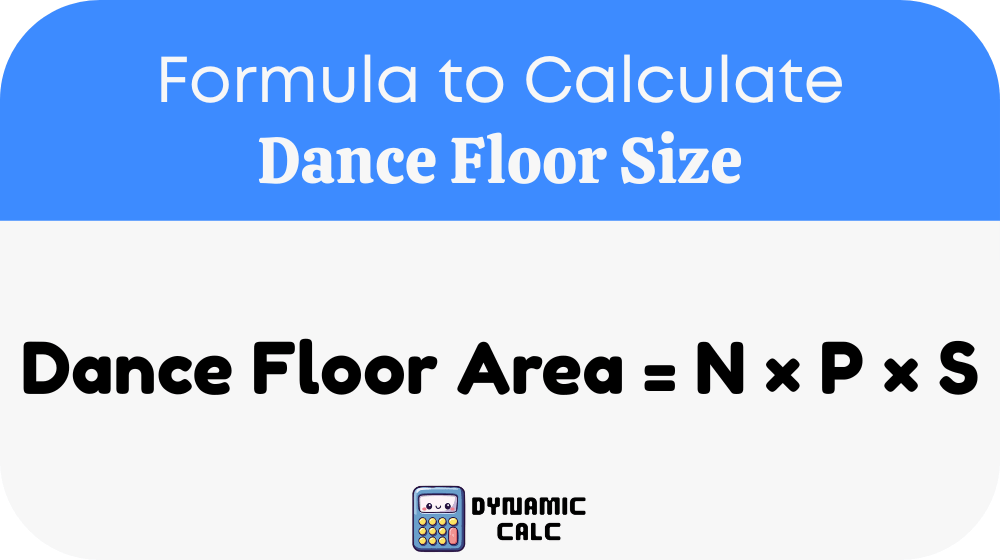
Where:
- N = Total Number of Guests
- P = Percentage of Guests Expected to Dance (expressed as a decimal)
- S = Space Required per Dancer (square feet)
Variables Explained
| Variable | Description | Example |
|---|---|---|
| N | Total event guests | 200 |
| P | Expected dancing participation rate | 0.50 (50%) |
| S | Space per dancer | 6 sq ft |
| Result | Required dance floor area | 600 sq ft |
Quick Reference Dance Floor Size Table
The following table provides common estimates used by event planners.
| Total Guests | Estimated Dancers (50%) | Recommended Area (6 sq ft per dancer) | Suggested Floor Size |
|---|---|---|---|
| 50 | 25 | 150 sq ft | 12′ × 12′ |
| 75 | 38 | 228 sq ft | 15′ × 15′ |
| 100 | 50 | 300 sq ft | 18′ × 18′ |
| 150 | 75 | 450 sq ft | 20′ × 24′ |
| 200 | 100 | 600 sq ft | 24′ × 25′ |
| 250 | 125 | 750 sq ft | 25′ × 30′ |
| 300 | 150 | 900 sq ft | 30′ × 30′ |
| 400 | 200 | 1,200 sq ft | 30′ × 40′ |
| 500 | 250 | 1,500 sq ft | 30′ × 50′ |
Example
Suppose an event has 200 guests.
- Total Guests (N) = 200
- Expected Participation Rate (P) = 50% = 0.50
- Space per Dancer (S) = 6 square feet
Calculation:
Dance Floor Area = 200 × 0.50 × 6
Dance Floor Area = 600 square feet
Therefore, the event should have approximately 600 square feet of dance floor space. Suitable dimensions could include 20 feet × 30 feet or 24 feet × 25 feet, depending on the venue layout.
Applications
Wedding Reception Planning
Wedding planners frequently use Dance Floor Size Calculators to ensure guests have sufficient room for dancing throughout the reception. Accurate calculations help balance dining areas, entertainment zones, and dance spaces within the venue.
Corporate Events and Parties
Corporate gatherings often include entertainment and social activities. Event organizers use dance floor calculations to create comfortable environments that encourage participation while maintaining efficient use of venue space.
Concerts, Festivals, and Community Events
Large public events require careful crowd management. Dance floor calculations help organizers estimate movement areas, improve safety planning, and maximize attendee comfort during performances and celebrations.
Most Common FAQs
What is the ideal dance floor size for a wedding?
The ideal dance floor size depends on guest count and expected participation. Most wedding planners assume that approximately 50% of attendees will dance at the same time. For example, a wedding with 200 guests typically requires around 600 square feet of dance floor space. However, events with younger crowds or energetic entertainment may need larger dance floors. Using a Dance Floor Size Calculator provides a more accurate estimate than relying solely on standard venue recommendations.
How much space should each dancer have?
Most event planning guidelines recommend allocating between 4 and 9 square feet per dancer. Formal events with slower dancing can often use 4 to 6 square feet per person. In contrast, parties featuring energetic dancing benefit from 7 to 9 square feet per participant. The appropriate amount depends on the event style, guest demographics, and expected activity level. Providing adequate space improves comfort, safety, and overall enjoyment.
What percentage of guests usually dance?
The percentage varies significantly based on the type of event. Weddings often see 40% to 70% participation, while corporate events may range between 20% and 50%. Factors such as music selection, age groups, cultural traditions, and event atmosphere influence participation rates. Many professional planners use 50% as a reliable starting estimate. Nevertheless, adjusting the percentage according to event-specific factors produces more accurate calculations.